14 Best Marketing Automation Tools of 2026: Get More Done
Marketing used to demand constant attention — posting, emailing, following up, tracking, analyzing, repeating. Now?
Automation does the heavy lifting.
But with so many platforms claiming to be “the best,” choosing the right one gets overwhelming fast.
So I made it simple.
Below are the 14 best marketing automation tools of 2026, what they’re best at, and who they’re for — so you can pick the right platform without wasting hours researching.
Table of Contents
1. ActiveCampaign: One of the All-Time Best Marketing Automation Tools

ActiveCampaign is one of the best marketing automation tools for a reason — it’s ridiculously powerful without being complicated.
It learns from user behavior, automatically optimizes your send times, and includes more than 30,000 automation recipes you can plug into instantly.
Why it’s a top tool:
- Machine learning that predicts what actions (and timing) perform best
- Massive automation template library
- Email tracking, contact management, and workflow building inside a Chrome extension
- Integrations with Shopify, Salesforce, WordPress, and hundreds more
If you want marketing that feels smarter every week, ActiveCampaign is hard to beat.
2. Adobe Marketo Engage

Marketo Engage is the “enterprise powerhouse” of automation platforms.
If you want deep personalization, advanced lead scoring, and multi-touch attribution, this is it.
Why it stands out:
- Tracks customer behavior across every touchpoint
- Personalizes campaigns at scale
- Aligns marketing + sales through shared data
- Great for teams wanting an all-in-one lifecycle solution
Marketo is one of the best marketing automation tools because it gives you a fully mapped customer journey and removes a ton of manual work from marketing departments.
3. Customer.io

Customer.io is perfect if you want behavior-based messaging without clunky workflows.
Best for: SaaS companies, apps, subscription businesses, and anyone who needs triggered communication.
What it does:
- Sends targeted email, SMS, and push messages
- Automates messages based on rules or user actions
- API-triggered messaging for deeper customization
- HIPAA, GDPR, and SOC 2 compliant (great for sensitive industries)
- Real-time analytics and segmentation
Customer.io shines as a marketing automation tool when you need fast, personalized communication for large audiences.
4. HubSpot: A Legend in the World of the Best Marketing Automation Tools
Hey, let’s play a quick game. Think of any digital marketing term.
Got it? Go type it into Google, and I bet HubSpot appears in the results pages. Yeah, they’ve got a pretty good idea of how to be effective digital marketers.
HubSpot is the maker of marketing automation tools that everyone knows — because it does almost everything.
Their automation suite covers email, CRM, social scheduling, analytics, customer service, and sales.
Email automation:
Personalized subject lines, smart workflows, A/B testing, and dynamic content.
Social media automation:
Schedule posts, monitor brand mentions, and jump into conversations from the same dashboard.
Why it’s great:
Everything ties back into one unified CRM, making HubSpot ideal for companies that want their sales, service, and marketing data connected.
5. Mailchimp
Mailchimp used to be “just” an email tool.
Now it’s a full marketing platform built for small and medium-sized businesses. It’s also one of the best marketing automation tools.
What Mailchimp now automates:
- Email campaigns
- Pre-built customer journeys
- Landing pages
- Ads
- Customer segmentation
- Basic store creation + ecommerce automations
It integrates with nearly everything, making it a good choice if you want an easy, affordable solution that still scales well.
6. Oracle Eloqua
Eloqua is Oracle’s enterprise-level automation platform—and it’s built for B2B companies with long sales cycles.
What makes Eloqua powerful:
- Drag-and-drop campaign builders
- AI-driven email personalization
- Predictive scoring models
- Deep analytics for multi-step buyer journeys
- Shared data between sales + marketing teams
Eloqua is the best marketing automation tool for businesses that need complex automations without endless manual work.
7. Constant Contact
Another incredibly popular email marketing program is Constant Contact.
This is one of the oldest and easiest email marketing tools on the market — and still a favorite for small businesses.
Why users love it:
- Hundreds of ready-to-go email templates
- Drag-and-drop builder
- Real-time analytics
- Tools for surveys, sign-up forms, and customer management
- Integrations with Shopify, Salesforce, and many others
It’s not the flashiest platform, but it’s a reliable and great marketing automation tool for teams with limited time or design resources.
8. Brevo
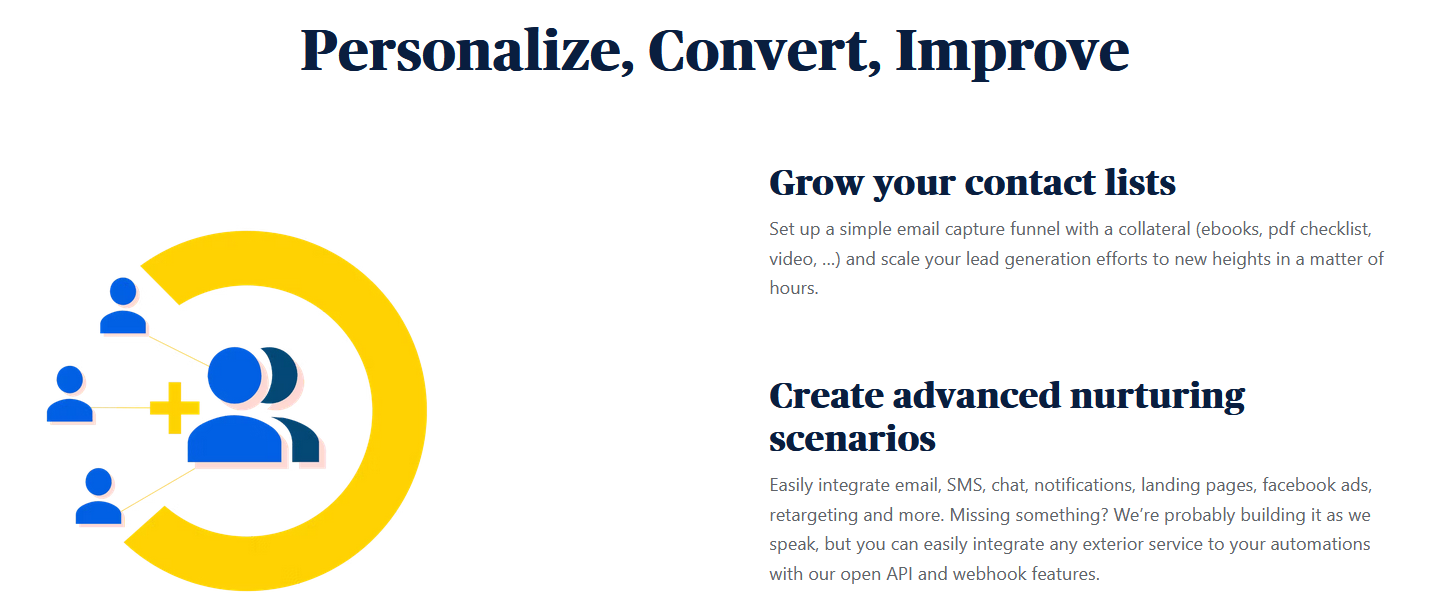
SendinBlue (now known as Brevo, but many still call it SendinBlue) is a strong multi-channel automation platform.
What it handles:
- SMS
- Chat
- Automated workflows
- Audience segmentation
- Social media ads
- Landing pages
It’s one of the most affordable marketing automation tools for businesses that want email + SMS + social ads in one place.
9. GetResponse
GetResponse is popular for creators, online educators, and ecommerce businesses that want simple but flexible automation.
What it’s great at:
- Visual automation builder
- Lead magnet funnels
- Webinars + landing pages
- Behavior tracking
- Personalized email sequences
- Customer engagement scoring
If you want a tool that combines funnels + email + automation, GetResponse is an excellent fit and hands-down one of the best marketing automation tools.
10. Keap
Keap (formerly Infusionsoft) is built for entrepreneurs and service-based businesses that want automation + payments + CRM in one place.
Key features:
- Visual automation builder
- Follow-up reminders
- Lead scoring
- Sales pipeline management
- Integrated payment collection
- Personalized workflows without coding
Plus, Keap Academy helps users learn automations step-by-step.
11. Klaviyo
Klaviyo is the best marketing automation tool for ecommerce brands.
Why ecommerce stores love it:
- Real-time SMS and email
- Price drop alerts
- Shipping updates
- Cart abandonment flows
- Personalized product recommendations
- Deep Shopify & BigCommerce integrations
Klaviyo’s segmentation is unmatched for online stores — it knows what customers browse, buy, and ignore, and responds instantly.
12. SharpSpring
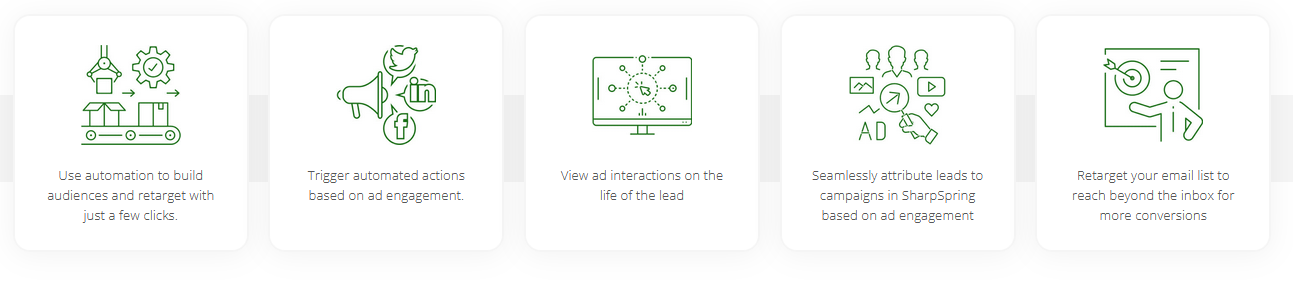
SharpSpring is a solid automation and revenue growth platform that works especially well for agencies and performance-driven teams.
What it does well:
- Multi-channel automation
- Dynamic forms
- Lead scoring
- Retargeting ads
- Personalized email and content
- Pipeline tracking
The built-in retargeting tools make it especially strong for teams focused on lowering acquisition costs.
13. Pardot (Salesforce Marketing Cloud Account Engagement)
Pardot (now part of Salesforce, though still commonly referred to as Pardot) is a leading B2B automation tool.
Top strengths:
- Email campaign automation
- Landing page builder
- ROI + attribution reporting
- Lead nurturing + scoring
- SEO analytics
- Customer journey mapping
It’s ideal for companies already using Salesforce CRM.
14. Automizy
Automizy focuses on one thing: better email open rates.
What it offers:
- Smart subject line testing
- Drag-and-drop email builder
- Automated email sequences
- Landing pages
- Forms
- Lead capture workflows
It’s simple, clean, and built for teams that want affordable email automation without complexity.
Final Thoughts
Marketing gets easier the moment you stop doing everything manually.
The tools above can automate emails, social posts, customer journeys, sales follow-ups, and even your analytics — so you can spend more time on content, strategy, and growth.
Choose the tool that fits your business model, test it for a week, and watch how much time you get back.

Alex Eagleton is a copywriter and digital marketer with a decade of experience helping companies connect with their audiences. He’s written for brands such as Microsoft, Roku, and Ramsey Solutions, and specializes in creating content that not only informs but drives measurable results. Known for his versatility, Alex adapts seamlessly to different voices and tones, making him a trusted partner for businesses looking to grow through content.
When he’s not writing, he enjoys spending time with his dogs, reading, and playing guitar.
You can reach him by emailing alex@contentmarketinglife.com.